Back to Research
SOUFFLE
Air and Breath as Compositional Material
2017–2022
PhD in Composition
University of Leeds
Souffle investigates air, breath and friction as a porous continuum of compositional material. Moving beyond breath as an isolated effect or extended technique, the research follows how contact, resonance, spatialisation and multiplicity can transform souffle into an organising principle for gesture, time, perception and musical form.

RESEARCH PREMISE
The Idea of Souffle
Beyond air and breath
“Souffle” has no exact equivalent in English. It may mean breath, air, wind, or an air-like sound, allowing physical cause and sonic result, human and instrumental sources to remain deliberately unresolved. This ambiguity becomes the starting point of the research.
Rather than a collection of extended techniques, souffle is approached as a porous, polymorphic metamaterial: a continuum of air, breath and friction whose states can merge, filter and transform one another. Across the nine-work corpus, it progressively acts as a meta-parameter, connecting timbre, gesture, resonance, space, musical time and form.
RESEARCH STRUCTURE
Three Axes, Three Compositional Expansions
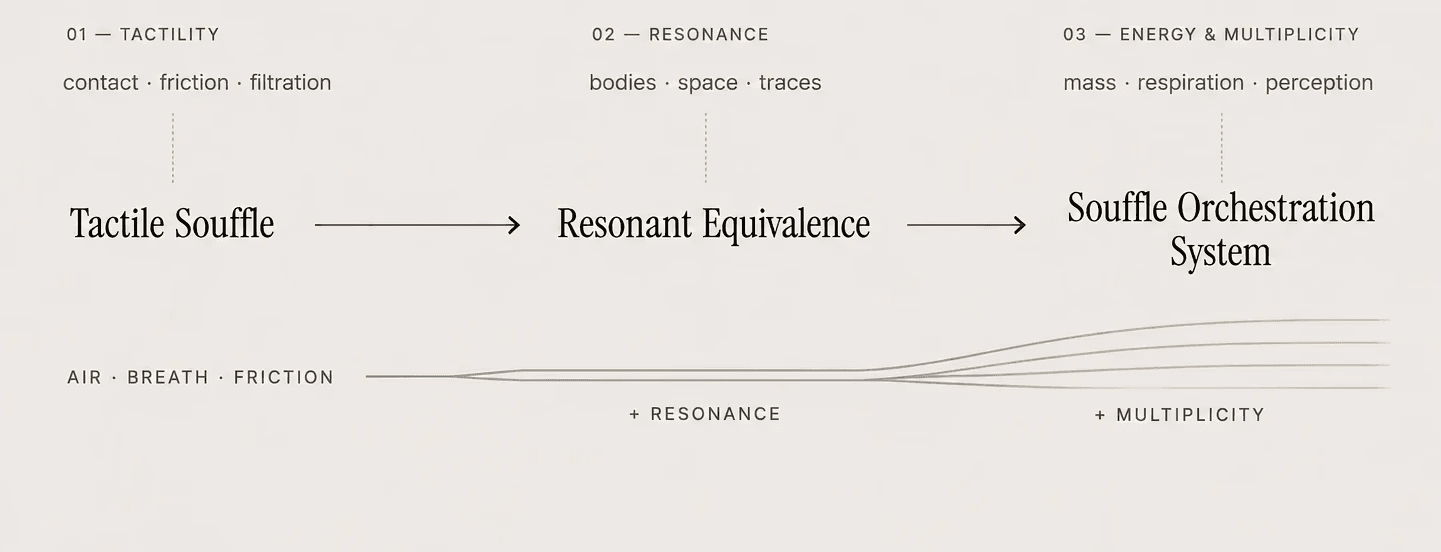
Across nine works, souffle develops through three cumulative expansions. Tactility detaches breath from respiration through contact and friction. Resonance extends it across bodies, instruments, spaces and traces. Energy & Multiplicity transforms this expanded continuum into orchestral mass, temporal organisation and perception.


01 — TACTILITY
Touching Air
Air as contact, friction and instrumental matter.
Here, souffle is approached through contact and friction rather than respiration alone. Instrumental surfaces become filters: material, pressure, speed and contact transform friction into air-like sound, extending breath beyond its physiological duration. From near-silence to vibration, grain and overpressure, tactile souffle forms a continuous pathway between contrasting states of matter.

RELATED CORPUS
RESEARCH CONTRIBUTION
Tactile Souffle
Friction turns instrumental contact into an independent source and filtration system for souffle. By releasing breath-like sound from the limits of respiration, tactile interactions can move continuously between air, vibration, grain and saturation, making material transformation itself a generator of musical time and form.


CORPUS & METHOD
Nine Works, One Compositional System
The nine compositions do not simply illustrate the three research axes. Together they constitute the research method, allowing materials, processes and findings to develop within each axis while migrating across the wider corpus.
OVERALL RESEARCH CONTRIBUTION
Souffle as a Meta-Parameter
Across the nine works, souffle evolves from a family of air and breath sounds into a transversal compositional framework. Its porous and polymorphic states connect matter, gesture, resonance, space, musical time, perception and orchestral energy, allowing souffle to operate across — rather than within — individual compositional parameters.
BEYOND THE CORPUS
Deux souffles enlacés

TUNISIA · VILLA SALAMMBÔ
Breath across instrumental traditions and hybrid lutherie.
Developed in Tunisia, Deux souffles enlacés extends the Souffle paradigm into a North African instrumental and modal context. The work brings together the nay and the Naylute — a recent hybrid instrument connecting characteristics of the Arabic nay and Western flute — through breath, whistle, air leakage, voice and near-silence. Guided and free improvisation open the material towards maqām-related colours and modes of interaction beyond the original doctoral corpus.
Beyond the original corpus, the work tests how souffle can migrate across instrumental morphologies, performance practices and cultural contexts.
CONTINUING RESEARCH
From Souffle to Instrumental Transformation
The research developed beyond the original corpus along two interconnected paths. Spatialisation expanded souffle into architectural space in works such as Composer l’espace, while the sympathetic resonance explored in Un eco di soffio II led to the Extended Pedal — shifting the research from the transformation of sound towards the transformation of the instrument itself.
RESEARCH CONTINUATIONS
Related Research
Extended Pedal
RESONANCE AS INSTRUMENTAL CONTROL
An external mechanism makes the resonance of the grand piano directly performable, extending questions first developed through Un eco di soffio II.
Explore Extended Pedal
Organic Augmented Instruments
FROM EXTENSION TO ACTIVE INSTRUMENTS
The research expands from resonance control towards non-invasive active augmentation, transforming acoustic instruments into resonating bodies for amplified and electronic sound.
Explore Organic Augmented Instruments
RESEARCH
Explore the complete research landscape.
Return to the Research index to discover the connections between Souffle, instrumental resonance and active acoustic instruments.
Back to All Research