RESEARCH / ACTIVE AMPLIFICATION
Organic Augmented Instruments
Non-Invasive Active Amplification for Acoustic Instruments
This research develops external, removable systems that allow acoustic instruments to receive, transform and re-emit sound through their own resonating bodies. Contact microphones, vibration transducers and performer-controlled amplification create a circuit in which gesture, acoustic matter and electronics remain physically connected.

RESEARCH PREMISE
Making the Instrument Itself Active
Conventional amplification projects sound away from the instrument. Here, sound is returned into the wood, strings, bridge, frame or soundboard. The acoustic body becomes simultaneously a source, a loudspeaker, a filter and a resonant processor.
Electronics do not replace instrumental resonance; they enter it.

Direct contact between an active-amplification sensor and the instrument body.
THE SYSTEM
Three Interdependent Operations

Contact sensor mounted on the bow.
01 — CAPTURE
Contact microphones and bow-mounted sensors reveal vibration at the point where the gesture meets the instrument.
02 — ACTIVATION
External vibration transducers return sound directly into the acoustic body, activating its strings, wood, frame or soundboard.

Vibration transducer attached to the cello body.

Active system integrated into the performer’s playing situation.
03 — PERFORMANCE CONTROL
Routing, amplification, feedback and resonance remain performable parameters. The musician does not merely trigger a system but continuously reshapes its behaviour.
Capture, transformation and re-injection become parts of the same instrumental gesture.
DESIGN PRINCIPLE
External, Removable, Adaptable
Each system is mounted externally to the instrument and can be removed without permanent structural alteration. Its configuration is developed in response to the morphology, materials and acoustic behaviour of each instrument.
Rather than imposing a standardised device, the research preserves the construction and acoustic identity of the instrument while adapting capture and activation to its specific resonant properties.
Non-invasive
— No permanent modification of the instrument.
Removable
— Sensors and transducers can be installed and removed.
Adaptable
— The system changes according to instrumental morphology and mode of vibration.

COMPOSITIONAL APPLICATIONS
Works as Research Environments
The system does not precede the music as a fixed technical solution. Each work becomes a research environment in which instruments, performers, amplification and compositional form are developed together.
The following works progressively explore active resonance, reciprocal diffusion, feedback, bodily capture and expanded instrumental configurations.
BRIDGE WORK — FROM EXTENDED PEDAL TO ACTIVE INSTRUMENTS
Reverberated Feedbacks
Reverberated Feedbacks marks the transition from Extended Pedal research to Organic Augmented Instruments. Relocated damper control is combined with active amplification, allowing feedback to be projected into the piano and transformed through its strings, soundboard, frame and pedal-controlled resonance.
The piano becomes an acoustic processor: mechanical resonance, performer-controlled amplification and feedback operate as parts of a single hybrid instrument.

Extended-pedal control and active amplification merge within the resonating body of the piano.
PIANO AND CELLO WITH ACTIVE AMPLIFICATION
Solar Winds
Solar Winds creates a reciprocal system between piano and cello. Each performer can activate both the interior of their own instrument and the resonant body of the other.
A contact microphone attached to the bow captures friction at its source, while vibration transducers return processed material into wood, strings and soundboards. Recordings derived from solar winds and magnetic fields enter this circuit, where they are filtered through instrumental matter rather than simply reproduced through external loudspeakers.


Bow-mounted contact sensor.

Vibration transducer attached to the cello soundboard.

Score excerpt — active amplification, recorded fields and performer-controlled feedback.
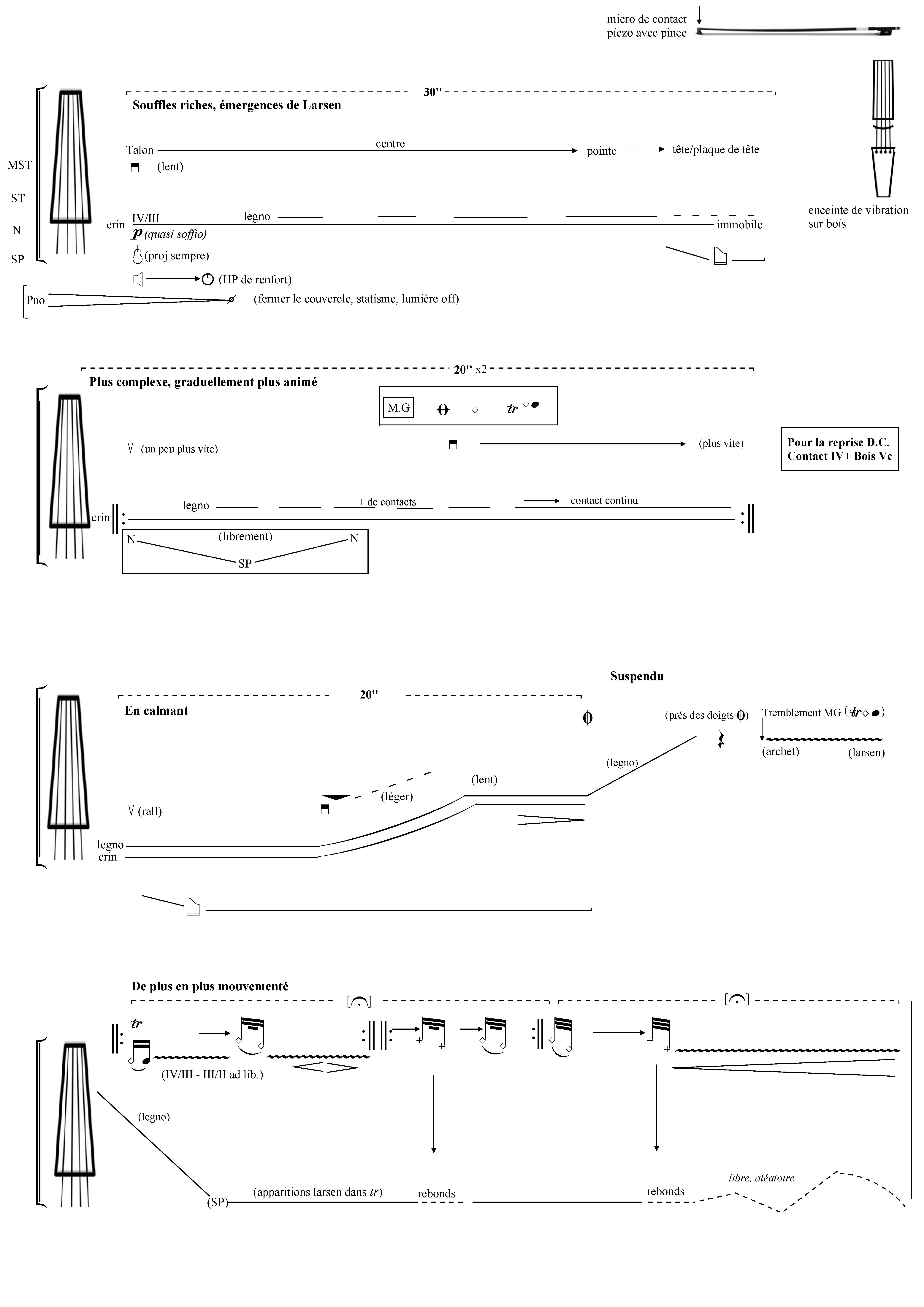
Score excerpt — transformations between instrumental resonance and processed sound.
FLUTE AND DOUBLE BASS WITH ACTIVE AMPLIFICATION
Emergence of Speakings
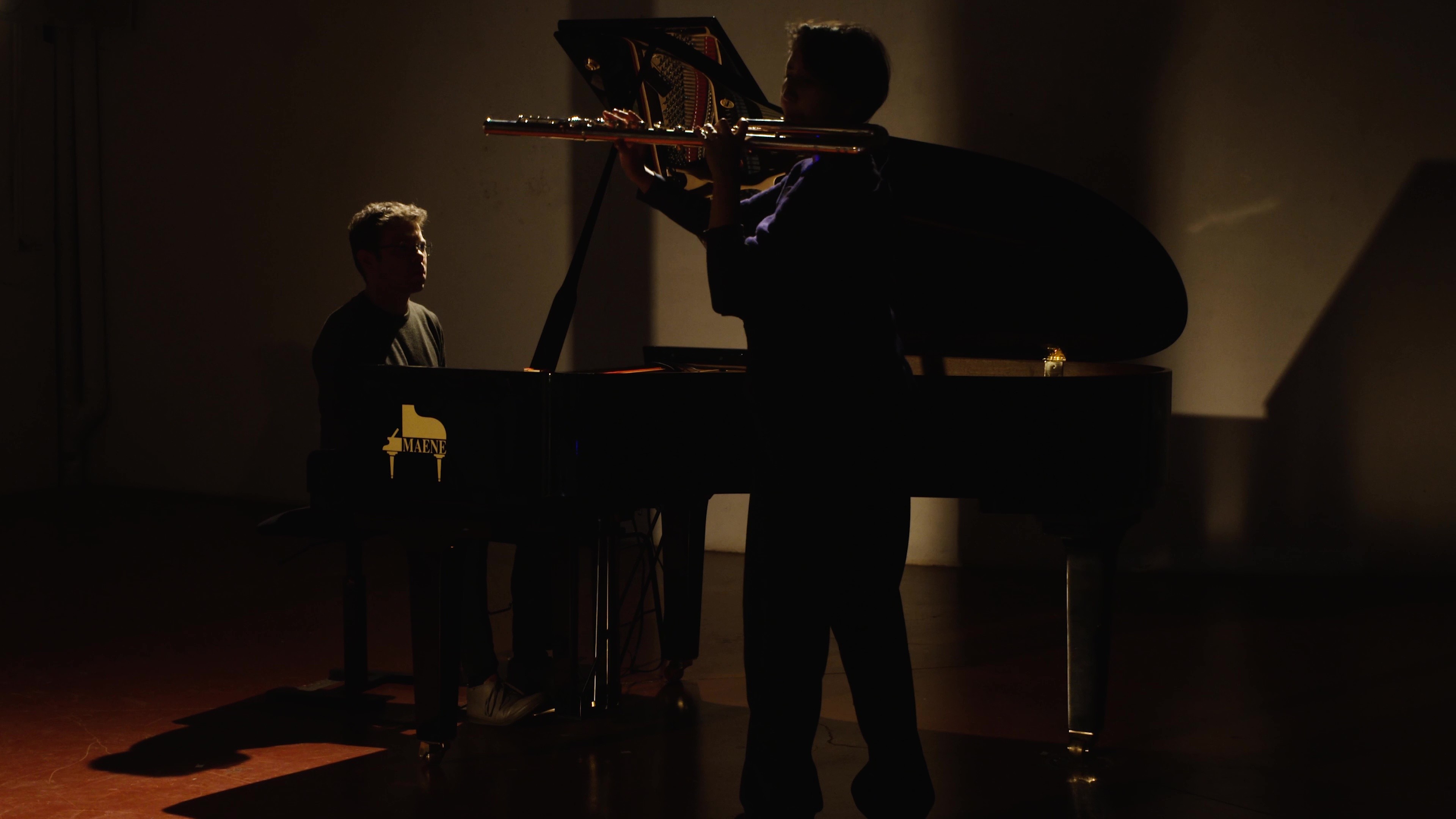
Emergence of Speakings explores the threshold at which instrumental noise, breath, friction and feedback begin to resemble speech.
The flautist brings a contact microphone into physical contact with the tube, keys and mechanisms of the instrument. Rather than capturing only the projected flute sound, the microphone reveals impacts, unstable textures, friction and mechanical granulations at extremely close range.
ASMR material appears both as a recorded layer and as an embodied practice. Mouth sounds, whispered breath and close friction are performed by the musicians and circulate between acoustic gesture, amplification and recording.
Two Bows, Two Instrumental Functions
The double bassist uses two bows. The principal active bow is equipped with a contact sensor and alternates between hair and wood. Its amplification and feedback change according to the point of contact, pressure and angle of the gesture.
A second bow enters during the final movement for a more conventional action on the strings. It does not replace the amplified bow but adds another layer of articulation, allowing two distinct bowing behaviours to coexist.
Watch the Film


Two bows, two instrumental functions.

Flute, mouth and breath at close range.
ACTIVE PIANO AND FIVE SPATIALISED MUSICIANS
Feed the Monster
Feed the Monster turns the grand piano into a central resonant organism. Five musicians positioned around the space project sound towards the instrument. The piano receives, absorbs and re-emits this material through its strings, frame and soundboard.
The performers do not simply accompany the piano. Their sounds enter its body and are transformed by its physical construction. The pianist controls the active system from inside the instrument, shaping amplification, filtering, feedback and the migration of sound between distant performers and the central resonant body.
The piano becomes an acoustic processor: a body capable of swallowing, transforming and returning the sounds that surround it.
Watch Feed the Monster


The interior of the piano becomes a performable and actively amplified surface.

Sound is projected into the piano while the pianist controls its transformation from within the instrument.
BEYOND INSTRUMENTS
Performing the Spaces
Performing the Spaces transfers active amplification and feedback from musical instruments to architectural and landscape bodies.
Metal plates, parabolic surfaces, walls, stairways and other structures become resonators, filters and unstable loudspeakers. The principle remains related to the augmented instrument, but the instrumental body is no longer a violin, piano or double bass. It may be a surface, a fragment of architecture or an entire site.

Each work is composed in situ. The method begins with the acoustic behaviour, material memory and circulation of a place: monumental metal structures, ruins, water edges, exterior paths and unconventional interiors.
Sound is not placed inside a finished space. It is discovered through contact, movement, echo and repeated activation.
Performer itinerancy and audience movement transform listening into a route rather than a fixed viewpoint. Composition emerges from the distances between bodies, surfaces and successive acoustic perspectives.

Direct contact between amplification and the metallic surface.

Architecture, passage and the route between interior and exterior.

Audience and performers move together through the site as a collective route.
RESEARCH CONTRIBUTIONS
What the System Makes Possible
01
Resonant Processing
Acoustic bodies become active processors capable of receiving, filtering and redistributing sound.
02
Performer Agency
Capture, routing, re-injection and feedback remain directly connected to instrumental gesture.
03
Reversible Instrumental Design
External systems adapt to different acoustic bodies without permanent structural intervention.
04
Expanded Resonant Bodies
The principle can extend from instruments to architectural, metallic and landscape structures.
CONTINUING RESEARCH
Toward an Ecology of Resonant Bodies
Organic Augmented Instruments is not a single device but a family of evolving situations. Each prototype begins with the physical behaviour of a particular body and asks how sound can circulate through it without erasing its acoustic identity.
The research therefore moves from instruments toward spaces while retaining the same central concern: the intimate relation between gesture, material, amplification and return.
PRECEDING RESEARCH
EXTENDED PEDAL
Relocating damper control and transforming the grand piano into an open instrumental body.
FOUNDATIONAL RESEARCH
SOUFFLE
Air and breath as physical, gestural and compositional material.