Back to Research
SOUFFLE
Air and Breath as Compositional Material
2017–2022
PhD in Composition
University of Leeds
Souffle investigates air, breath and friction as a continuum of compositional materials. Rather than treating breath as an isolated effect or extended technique, the research connects bodily respiration, instrumental vibration, gesture, resonance, energy and musical form.
Explore the Research
Read the PhD Thesis

RESEARCH PREMISE
The Idea of Souffle
Beyond air and breath
“Souffle” has no exact equivalent in English. It may mean breath, air, wind, or an air-like sound, referring at once to a physical action and to its sonic result. This ambiguity is the starting point of the research: souffle connects human respiration, instrumental air and friction, blurring the distinction between human and instrumental sound sources.
Rather than a collection of extended techniques, souffle became a compositional lens — a principle of timbre, gesture, resonance, temporality, energy and form, opening new thresholds between body, instrument and sound. Across the doctoral research, this lens was developed and tested through a corpus of nine compositions.
RESEARCH STRUCTURE
Three Research Axes
The nine-work corpus develops through three interrelated dimensions: tactility, resonance, and energy and multiplicity. These dimensions do not form isolated categories; they interact, overlap and extend one another throughout the research.


Souffle develops through three interrelated dimensions: tactility, resonance, and energy and multiplicity.

01 — TACTILITY
Touching Air
Air as contact, friction and instrumental matter.
Here air is approached through contact and friction rather than respiration alone. Bow friction, grazing pressure and unstable noise generate fragile, near-silent gestures at the surface of the instrument, which becomes a zone of filtration between quietness, resonance and saturation. Friction is treated as both sound material and corporeal gesture.

RELATED CORPUS
DEVELOPMENT WITHIN THIS AXIS
Circle(s) treats air and friction as a topology of contact; Un eco di soffio explores fragility, quietness and echo; Ra’ash pushes the same materials towards pressure, granulation and saturation, tracing a single axis across three distinct states of tactile intensity.


02 — RESONANCE
Hybrid Traces
The threshold between human breath, instrumental vibration and resonant space.
Resonance is treated as the meeting point between human and instrumental bodies, where source, action and sonic result become ambiguous. Sympathetic vibration and acoustic prolongation create hybrid states connecting breath, instrumental resonance and electronic extension — resonance as both a physical phenomenon and a perceptual mirror.
RELATED CORPUS
DEVELOPMENT WITHIN THIS AXIS
Ātma(n) hybridises performer and instrument into one resonant body; Un eco di soffio II lets breath activate sympathetic piano resonance; Tracer le souffle extends these resonances through amplification and electronic traces, tracing resonance from the acoustic body outward.
03 — ENERGY & MULTIPLICITY
Multiplier le souffle
Air as orchestral force, mass, flux and dynamic energy.
Beyond the chamber context, air becomes density, pressure, pulse and collective energy across ensemble, concerto and orchestral forces. Breath, friction, noise and instrumental masses combine into a principle of orchestration, moving between porosity, accumulation and saturation within large-scale temporal and dynamic structures.

RELATED CORPUS
DEVELOPMENT WITHIN THIS AXIS
Hólo(s) treats air as a full orchestration system; the Concerto pour piano et ensemble pushes virtuosity, pressure and breathlessness to their limit; Sha’aph explores pulse, stasis and mass at their extremes, together mapping the outer edge of this axis.
CORPUS
The Nine-Work Corpus
The nine compositions form a double reading grid. Each column develops one research axis, while the successive rows move from the construction of a compositional system through fragility and hybridisation towards more radical applications.

The three columns correspond to Tactility, Resonance, and Energy & Multiplicity. The rows move from the construction of a compositional system, through porosity and fragility, towards radical or extreme applications. Horizontal and vertical connections show how findings migrate between the works and across the research axes.
TACTILITY
ENERGY & MULTIPLICITY
View Full Research Matrix
WORKS
Selected Works
Three compositions provide distinct entry points into the tactile, resonant and energetic dimensions of Souffle.
Un eco di soffio
A work for two cellos in which tremolo, bariolage, glissando and fragile friction draw an echo of breath from contact with the strings. Guided improvisation and listening-based dialogue allow sound to emerge and recede at the threshold of silence.
Explore the Work

Ātma(n)
A chamber-ensemble work exploring the performer as an extension of the instrument. Human respiration, instrumental resonance and collective energy become part of one evolving body, progressing from fragile breath-based textures towards increasingly dense and forceful states.
Explore the Work
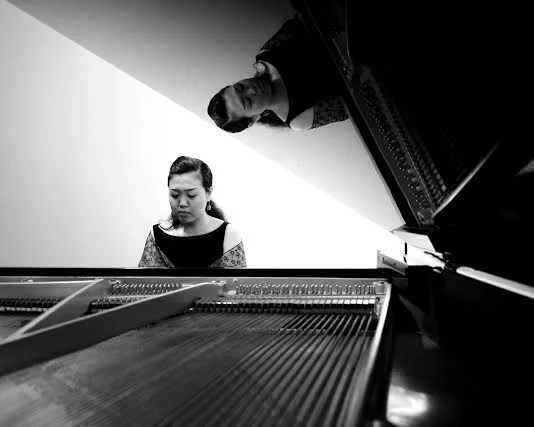
Concerto pour piano et ensemble
The concerto places the piano soloist against an ensemble conceived as a changing flux of air, noise and instrumental breath. Virtuosity, pressure and orchestral density develop towards breathlessness, leaving resonance and noise as the remaining traces of the musical body.
Explore the Work
CONTINUING PRACTICE
From Doctoral Research to Continuing Practice
The PhD was completed at the University of Leeds in 2022, with the nine compositions of Souffle forming its principal doctoral corpus. Souffle, however, remains an active compositional perspective rather than a closed historical project: its focus on resonance, embodiment, gesture and acoustic porosity continues to inform later work.
Extended Pedal develops questions of instrumental space and resonance through an external mechanism for the grand piano, while Organic Augmented Instruments extends acoustic bodies through active amplification. These are distinct investigations, connected not by a single method but by recurring artistic questions first raised through Souffle.
DOCTORAL RESEARCH
Read the Thesis
Souffle: Air and Breath as a Composition Material
PhD in Composition
University of Leeds
2022
Read the PhD Thesis
CONTINUING RESEARCH
Related Research
Extended Pedal
Rethinking the Body and Resonance of the Piano
An external mechanism expands performer movement around the grand piano while preserving direct control of its dampers and resonance.
Explore Extended Pedal
Organic Augmented Instruments
External Active Amplification for Acoustic Instruments
External and reversible systems transform acoustic instruments into active resonating bodies for amplified and electronic sound.
Explore Organic Augmentation
RESEARCH
Explore the complete research landscape.
Return to the Research index to discover the connections between Souffle, instrumental resonance and active acoustic instruments.
Back to All Research